

Cloud Cost Reduction: What Works and in Which Order
WHAT THE MAJOR FRAMEWORKS AGREE ON
Visibility and ownership come first. AWS's design principles include analysing and attributing expenditure so that costs can be tied to workload owners [W3]. The FinOps Foundation states that everyone takes ownership of their technology usage and that FinOps data should be accessible, timely and accurate [W2]. Google asks organisations to foster a culture of cost awareness, with the cost information people need to decide well [W5].
Usage before rate. Microsoft's Well-Architected Framework separates designing for usage optimization from designing for rate optimization [W4], and Microsoft's commitment guidance puts it bluntly: discounts reduce rates, not waste, so right-size first [W6]. Google's principle "optimize resource usage" asks you to provision only what you need [W5].
Continuous, not one-off. Google's fourth principle is to optimize continuously [W5], Microsoft's fifth is to monitor and optimize over time [W4], and the FinOps Foundation describes Inform, Optimize and Operate as phases teams cycle through repeatedly [W1].
Value, not just savings. The FinOps Foundation defines FinOps as a practice that maximises the business value of technology and creates financial accountability through collaboration between engineering, finance and business teams, and explicitly says it is not only about saving money [W1]. Unit economics, cost per unit of business output, is how its principles suggest demonstrating that value [W2].
THE FIVE-LAYER ORDER
Layer 1: Make every cost owned
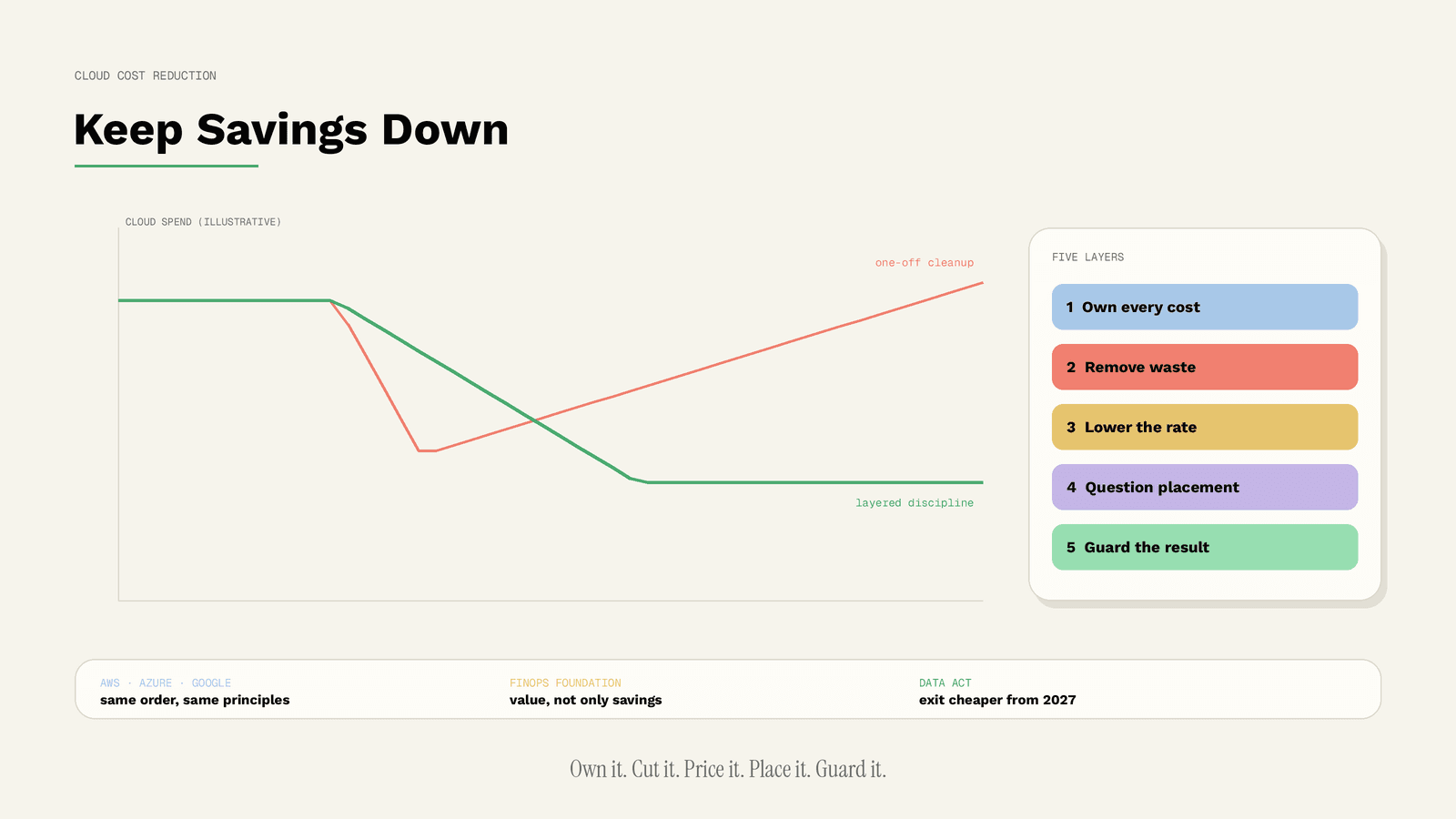
Before cutting anything, map spend to teams, products and environments. Without that, reductions cannot be prioritised, proven or sustained. In practice this means mandatory tags or labels, an owner for every account or project, and a shared view that finance and engineering both trust. Our article Where Multi-Cloud Spend Leaks goes deeper on attribution.
Layer 2: Remove waste
The quickest reductions are usually the least glamorous. AWS gives a simple illustration: development and test environments used eight hours a day on weekdays can cost about 75 percent less if stopped outside those hours, 40 hours instead of 168 [W3]. A published review of cost optimisation practice likewise lists non-production scheduling, storage lifecycle management and right-sizing oversized instances among the efforts that pay back fastest [S12]. That review is a lower-tier source, so treat it as practitioner experience, not measurement.
Layer 3: Lower the rate for what remains
Only after waste is gone do commitments make sense. One- or three-year commitments, such as reservations and savings plans, reduce the price of a stable baseline [W6]. The sequence matters because a commitment is a promise to pay: committing before right-sizing locks in today's waste for years. Licences you already own are part of this layer too, as are interruptible capacity options for workloads that can tolerate them.
Layer 4: Question where workloads run
This is the layer most programmes skip. A study modelling 23 infrastructure providers found that well-chosen multi-cloud bundles can be measurably more efficient than equivalent single-provider services, with gains that varied by service category [S20]. The honest reading is that placement can save money, but not automatically and not everywhere. Placement now carries less exit risk than it used to: under the EU Data Act, providers may not charge switching fees from 12 January 2027, and only reduced, cost-based fees are allowed until then [W7].
Layer 5: Keep the savings
Corrections decay. Non-production environments get left running again and oversized instances creep back. The same practitioner review describes automated guardrails as the way to stop old problems from returning [S12], which matches the "continuous" principle in every framework above [W1][W4][W5]. Budgets with alerts, anomaly detection and policies that block untagged or oversized resources turn a one-off cleanup into a standing discipline. How organisations mature this capability is covered in FinOps Maturity: From Visibility to Optimization.
WHY CLEANUPS DISAPPOINT
Many organisations run a cost reduction project, hit a target and see costs climb back within a few quarters. The frameworks explain why: they treat cost as an operating discipline, not an event [W1][W5]. A cleanup changes the bill once. It does not change who owns cost, how teams see it, or what stops waste from returning. That is why Layer 1 and Layer 5 matter more for the long-term result than any single discount.
There is also a measurement trap. Raw spend can fall while efficiency worsens, for example when a business shrinks a service. The FinOps Foundation's emphasis on unit economics, cost per transaction, customer or other business output, is the safeguard against that [W2].
WHAT THE EVIDENCE DOES NOT TELL YOU
Be careful with headline savings numbers. A systematic review of 57 studies on AI-driven cloud administration found that much of the published quantitative evidence comes from simulator settings, with limited reproducibility and generalisation under realistic conditions [S31]. Discount ceilings in provider documentation are maximums under specific conditions, not expected outcomes. The reliable way to size a reduction is to measure your own environment.
A PRACTICAL 90-DAY AGENDA FOR LEADERS
| Weeks | Focus | Outcome |
|---|---|---|
| 1 to 3 | Ownership and visibility | Every major cost line has an owner and a tag; one shared report |
| 4 to 6 | Waste removal | Non-production schedules, idle resources removed, oversized resources resized |
| 7 to 9 | Rate | Commitments sized to the cleaned baseline; existing licences applied |
| 10 to 11 | Placement review | Top workloads compared across regions and providers |
| 12 to 13 | Guardrails | Budgets, anomaly alerts, tagging and sizing policies; unit cost KPI agreed |
LIMITATIONS
This article synthesises provider and FinOps Foundation guidance as of 15 October 2026 and a small number of research sources of varying strength. The AWS 75 percent figure is an arithmetic illustration, not a benchmark. The multi-cloud efficiency finding comes from one study using 2021 pricing [S20]. The legal summary of the Data Act is operational analysis, not legal advice.
CONCLUSION
Cloud cost reduction is less about clever tricks than about doing the obvious things in the right order and refusing to stop. Own the cost, remove waste, lower the rate, question placement and guard the result.
Atomity supports every layer. It detects idle and oversized resources across AWS, Azure, Google Cloud and European clouds, compares where each workload runs most cost-effectively, including providers such as IONOS, STACKIT, OVHcloud, Hetzner and Open Telekom Cloud, and turns findings into draft pull requests, Jira tickets and Slack alerts so improvements actually ship. To see what your organisation could reduce, start with a free cloud cost check.
SOURCES
- [W1] FinOps Foundation: What is FinOps? (updated March 2026); FinOps Phases. https://www.finops.org/introduction/what-is-finops/ (accessed 15 October 2026)
- [W2] FinOps Foundation: FinOps Principles. https://www.finops.org/framework/principles/ (accessed 15 October 2026)
- [W3] AWS Well-Architected Framework, Cost Optimization Pillar: Design principles. https://docs.aws.amazon.com/wellarchitected/latest/cost-optimization-pillar/design-principles.html (accessed 15 October 2026)
- [W4] Microsoft Learn: Azure Well-Architected Framework, Cost Optimization design principles. https://learn.microsoft.com/en-us/azure/well-architected/cost-optimization/principles (accessed 15 October 2026)
- [W5] Google Cloud: Well-Architected Framework, Cost optimization pillar. https://docs.cloud.google.com/architecture/framework/cost-optimization (accessed 15 October 2026)
- [W6] Microsoft Learn: Decide between a savings plan and a reservation. https://learn.microsoft.com/en-us/azure/cost-management-billing/savings-plan/decide-between-savings-plan-reservation (accessed 15 October 2026)
- [W7] Regulation (EU) 2023/2854 (Data Act), Article 29. EUR-Lex. https://eur-lex.europa.eu/eli/reg/2023/2854/oj/eng (accessed 15 October 2026)
- [S12] Kasireddy, J. R. (2025). *The Cloud Cost-Optimization Flywheel: A Systematic Approach to Reducing Infrastructure Waste Without Compromising Delivery Velocity.* IJAESIT.
- [S20] Chatzithanasis, G., Filiopoulou, E., Michalakelis, C., Nikolaidou, M. (2021). *Exploring cost-efficient bundling in a multi-cloud environment.* Simulation Modelling Practice and Theory, Elsevier.
- [S31] Loku Nikçi, L., Ibrahimi, A., Dermaku, A., Ahmedi, B. (2026). *AI-Driven Cloud Administration: A Literature Review and Comparative Synthesis of Forecasting, Resource Allocation, Cost Optimization and Load Balancing Approaches.* International Journal of Innovative Technology and Interdisciplinary Sciences.
/ GET STARTED
Make Sovereign Cloud Decisions with Confidence
Turn sovereignty requirements into enforceable cloud decisions, with continuous visibility and evidence across providers.