

FinOps Maturity: From Visibility to Optimization
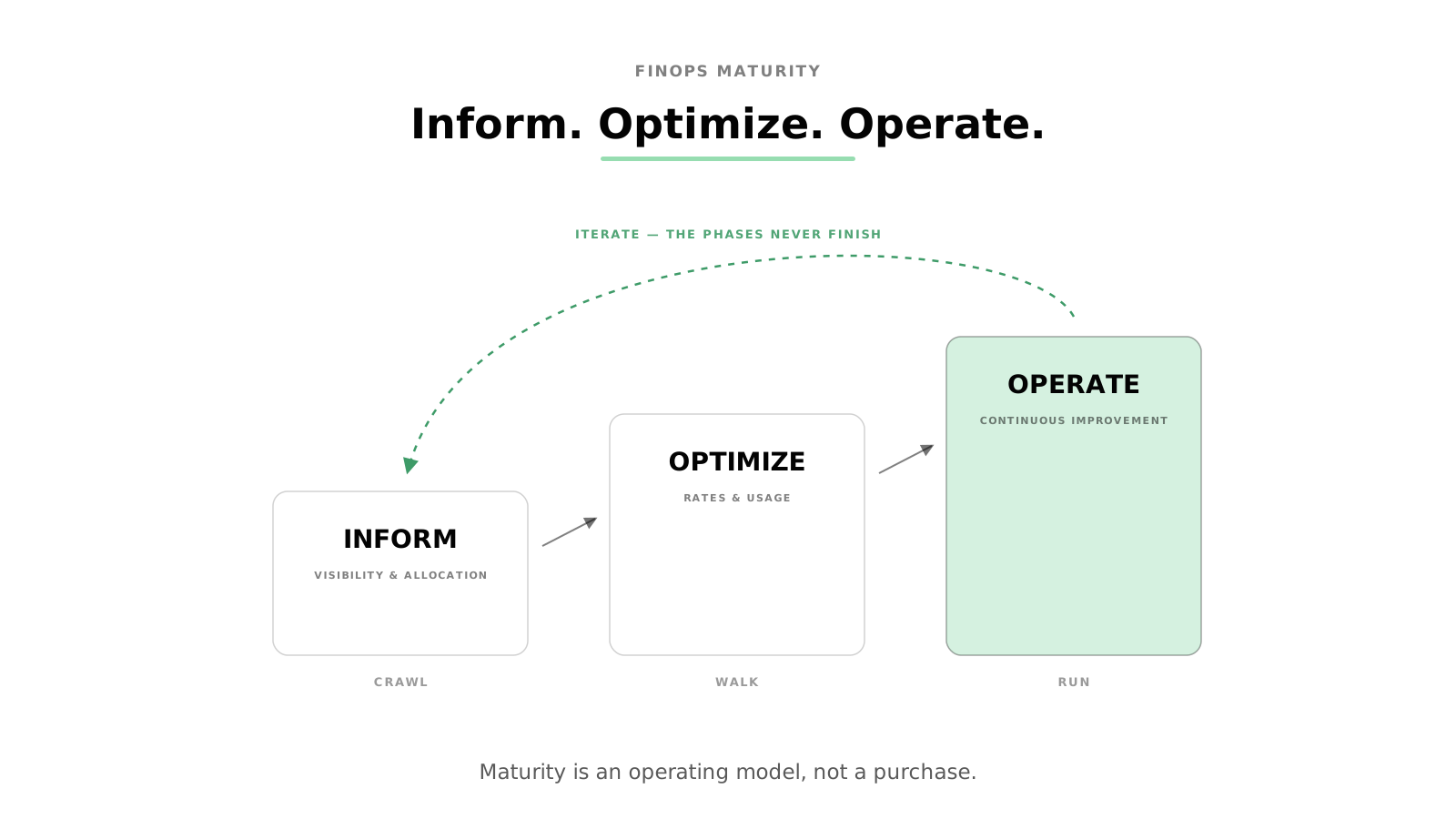
THE THREE PHASES: INFORM, OPTIMIZE, OPERATE
The FinOps Framework, maintained by the FinOps Foundation as a project series of the Linux Foundation, describes the practice in three phases [W1][S39].
Inform is "Visibility and Allocation." It is the work of making costs visible and assigning them to the right owner, through tagging, budgeting, forecasting, and cost-related KPIs [W1][S39]. Visibility is the half everyone attempts. Allocation is the harder half, and the one that makes everything later possible, because cost you cannot attribute to a team or product is cost no one is accountable for.
Optimize is "Rates and Usage." It is where an organisation identifies efficiency and value opportunities: rightsizing resources, managing commitments and contracts, and eliminating waste [W1][S28][S27]. There is no universal checklist here. The right optimization actions depend on the workloads and the environment.
Operate is "Continuous Improvement and Usage." It is where decisions are implemented and where collaborative, ongoing decision-making is established across teams [W1]. The word that matters is continuous. Operate is not a finish line. It is the state in which the practice keeps running.
The phases are iterative by design. A mature practice does not complete Inform, then Optimize, then Operate and stop. It cycles through them continuously, because new workloads, new services, and new pricing arrive constantly [W1].
CRAWL, WALK, RUN: MATURITY IS PER CAPABILITY, NOT A RACE
Alongside the phases, the framework describes a maturity model with three stages: Crawl, Walk, and Run [W1]. A capability at Crawl is limited in scale and addressed reactively. At Walk it is broader and more consistent. At Run it is automated, anticipated, and embedded in everyday decisions.
The important and frequently missed point is that the goal is not to reach Run everywhere [W1]. The aim is the appropriate maturity for each capability, given its value to the organisation. Some capabilities justify heavy automation. Others do not earn the investment, and forcing them to Run wastes effort that would be better spent elsewhere. Maturity is a set of deliberate choices about where rigour pays off, not a linear race to a single finish.
WHAT ACTUALLY CHANGES AS A PROGRAMME MATURES
Maturity is easiest to understand as a progression in what the practice can do.
At the start, the practice can see spend, usually after the fact and usually per provider. As it matures, that visibility becomes allocation: spend is mapped to teams, products, and business units through a consistent tagging strategy, and untagged resources, which create unallocated and therefore unaccountable cost, are driven down [S39][S28].
With allocation in place, reporting models become possible. Showback presents a team with the cost it has generated without billing it back. Chargeback bills that cost to the owning cost centre [S28]. Chargeback raises accountability sharply, but it depends on allocation being clean enough that teams trust the numbers, which is why it belongs to a more mature stage.
Mature practices also change the unit of measurement. Instead of reading a raw monthly bill, they track unit economics: cost per user, per request, or per transaction [S28][S12]. This connects spend to business activity, so that cost growth can be compared against business growth rather than judged in isolation. A bill that rises because the business doubled is a different signal from a bill that rises because resources are idle.
Finally, the way changes are enforced matures. Early on, corrections are manual and periodic. Later, they are institutionalised through guardrails, which are automated policies that hold a decision in place so it persists beyond the individual who made it [S28][S12]. The emphasis is on actionable guardrails rather than rigid controls that block teams from working.
FINOPS IS A CULTURAL SHIFT, NOT A DASHBOARD
It is tempting to read the phases as a technical pipeline. In practice, the harder change is organisational. FinOps is a financial discipline and a cultural practice that brings finance, engineering, and operations or product into the same conversation about cloud spend [S27][S28][S39]. Engineers gain visibility into the cost consequences of their architectural choices. Finance gains a language for cloud spend that is closer to how engineering actually works.
A healthy practice is also blameless. A cost spike is treated as something to understand and learn from, not someone to punish, and accountability for cloud cost is shared across teams rather than concentrated in a central function [S39][S27]. This matters because the moment cost reporting becomes a tool for blame, the data quality degrades: people stop tagging honestly and stop surfacing problems early. Culture is not a soft add-on to FinOps. It is the precondition for the data being trustworthy.
THE MATURE STATE: CONTINUOUS OPTIMIZATION AND GUARDRAILS
What does a mature practice look like in steady state? It runs as a loop rather than a project. One useful description of that loop is to observe spend, attribute it to a cause, correct the underlying behaviour, set automated guardrails so the correction holds, and validate the outcome before repeating [S12]. The point of the loop is durability. Without it, savings are recovered once and then quietly erode as new resources are provisioned and old habits return.
This is also where legacy approaches struggle. Fixed policies, manual control, and periodic reporting were adequate when environments were small and slow-moving. In dynamic, multi-cloud environments where resources scale and change continuously, those approaches fall behind the rate of change [S28][S60][S27]. Maturity, in this reading, is partly a response to speed: it is the set of practices that let cost discipline keep pace with infrastructure that no longer holds still.
Automation and machine learning can support the mature state, by detecting anomalies, forecasting demand, and surfacing optimization opportunities [S28][S60]. They are best understood as enablers of the Operate phase rather than as the definition of maturity. A practice does not become mature because it adds a model. It becomes mature because the operating model, including human accountability, is sound, and automation then makes it faster.
WHERE COST DISCIPLINE MEETS SUSTAINABILITY
At higher maturity, cost optimization and sustainability begin to converge. Much of what reduces cost, eliminating idle resources, rightsizing, improving utilisation, also reduces energy consumption, and a mature practice can treat carbon intensity and energy efficiency as governance dimensions alongside cost and performance [S36]. This is not a claim that cost and carbon are identical. They are not, and there are cases where they diverge. It is the more modest observation that a practice mature enough to attribute and govern cost is also positioned to attribute and govern environmental impact, because the underlying discipline, visibility, allocation, and accountability, is the same.
WHY PROGRAMMES STALL
Most FinOps programmes do not fail loudly. They stall. Three patterns recur. The first is mistaking a tool for the practice: the platform is bought, but allocation is never made clean and no one owns the decisions, so the dashboards are accurate and unused. The second is stopping at visibility: the organisation can see spend but never builds the allocation and accountability that turn visibility into action. The third is over-automating prematurely, pushing capabilities to Run before the underlying data and culture can support them, which produces confident automation acting on untrustworthy inputs.
The common thread is sequence. Maturity is the discipline of doing the phases in order and refusing to skip the unglamorous parts, especially allocation and accountability, because they are what everything else rests on.
LIMITATIONS
This article describes a framework and a direction of travel. It does not assert specific maturity-distribution figures, because reliable, verifiable industry percentages are not something this analysis can stand behind, and quantified savings claims tied to maturity vary widely across the literature and depend heavily on the starting point [S12][S36]. Treat any single headline number about FinOps maturity, including ones attached to tools, as directional rather than precise. The value of the model is in the sequence and the questions it prompts, not in a benchmark.
PRACTICAL NEXT STEPS
A practice that wants to mature can start with three honest questions. What share of our cloud spend is allocated to a clear owner, and what share is unattributed? Which of our cost decisions are held in place by automated guardrails, and which depend on a person remembering? And for the capabilities we have pushed toward automation, is the underlying data clean enough to trust the automation? Maturity is the unglamorous work of improving those answers over time.
As programmes reach the Operate phase, the questions begin to extend past cost alone, toward whether decisions can be governed and shown to hold across environments. That is where continuous optimization meets continuous auditability, and where evaluating cost alongside compliance and operational criteria, rather than in isolation, becomes the natural next step.
Map where your cloud spend is allocated today, and where it is not. The gap between the two is usually the most accurate measure of how mature your practice really is.
SOURCES
- [W1] FinOps Foundation. *FinOps Framework: Phases and Maturity Model.* Retrieved 2026-06-15. https://www.finops.org/framework/
- [S39] Korhonen, J. (2025). *Predicting Cloud Service Costs with Machine Learning: Design a Report in Power BI and Forecasting Model Using FinOps Inform Phase Principles.* University of Vaasa, MSc thesis. (Tier B.)
- [S27] Kodi, D. (2025). *Multi-Cloud FinOps: AI-Driven Cost Allocation and Optimization Strategies.* ICCSAIML'25, Eureka Vision. (Tier C.)
- [S28] Rusum, G. P., and Anasuri, S. (2024). *AI-Augmented Cloud Cost Optimization: Automating FinOps with Predictive Intelligence.* IJAIDSML. (Tier C.)
- [S12] Kasireddy, J. R. (2025). *The Cloud Cost-Optimization Flywheel.* IJAESIT. (Tier C.)
- [S60] *Intelligent FinOps Architectures: AI-Enabled Cost Optimisation and Forecasting in Cloud-Native Financial Platforms.* SSRN working paper, 2025. (Tier C preprint.)
- [S36] Sajja, J. W., Komarina, G. B., and Choppa, N. K. R. (2025). *The Convergence of Financial Efficiency and Sustainability in Enterprise Cloud Management.* JCSTS. (Tier C.)
/ GET STARTED
Make Sovereign Cloud Decisions with Confidence
Turn sovereignty requirements into enforceable cloud decisions, with continuous visibility and evidence across providers.