

Sovereign and Regional Cloud Strategy
TWO DEFINITIONS, KEPT NARROW
Two terms recur throughout, and they are worth pinning down briefly. A sovereign cloud, from the customer's point of view, is a cloud arrangement that offers a high degree of control over resources and over who can access the data, with the specific aim of reducing the risk that a provider subject to foreign jurisdiction discloses data to a foreign government without the customer's knowledge or permission [S55]. A regional cloud is the narrower idea of keeping data and processing within a defined geography, often to satisfy a residency or localization rule. The two overlap but are not the same: a regional region addresses location, while sovereignty addresses legal and operational control. Data localization is the regulatory requirement that certain data remain within national or regional borders [S40][S61].
THE DECISION IS BEING DRIVEN, NOT CHOSEN
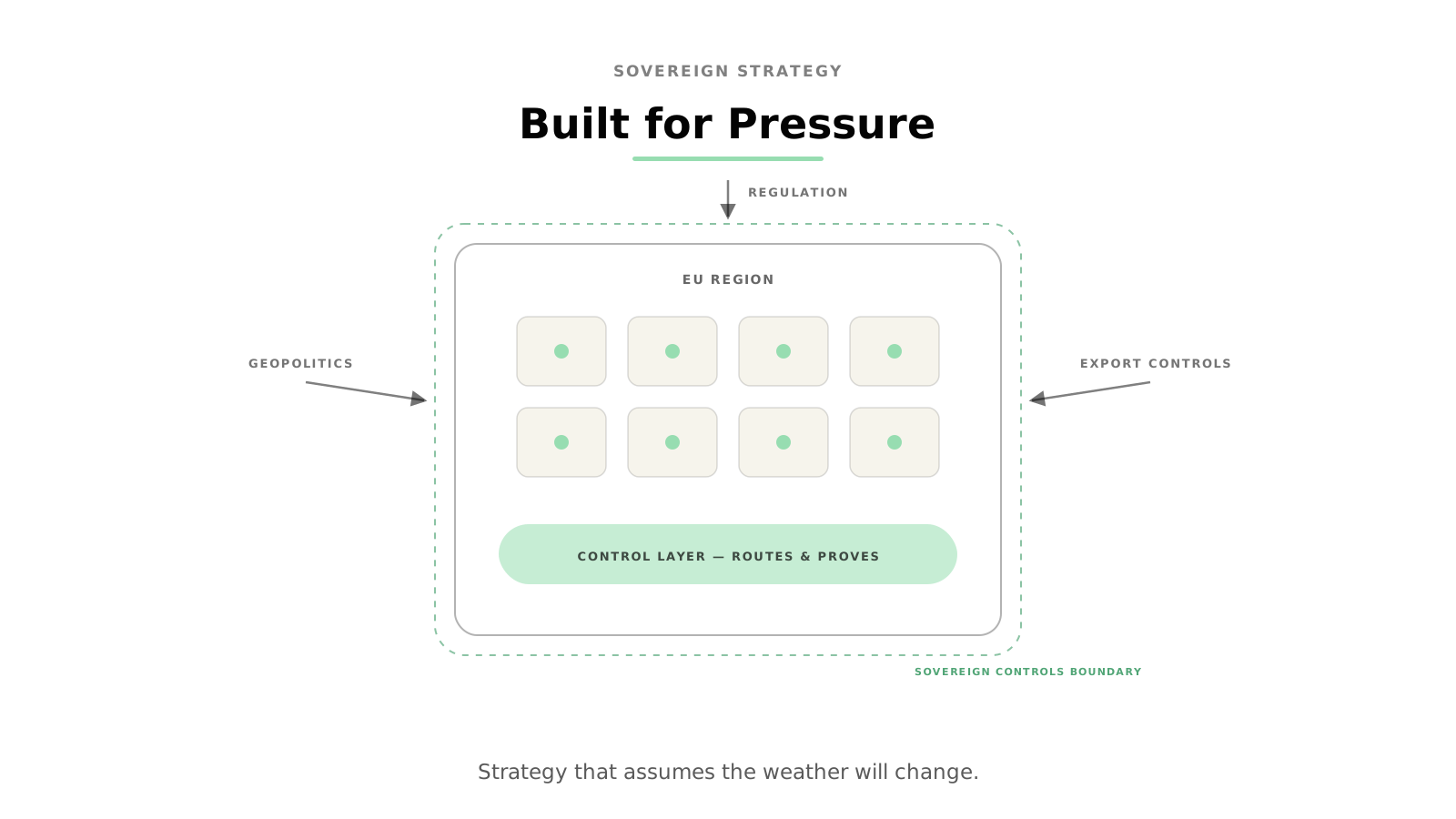
For most organisations, the trigger to consider a sovereign or regional move is external. Three pressures dominate.
The first is regulation, and it deserves to be stated precisely and kept separate from interpretation of it.
The law. In its judgment of 16 July 2020 in Case C-311/18, commonly called Schrems II, the Court of Justice of the European Union invalidated the European Commission adequacy decision underpinning the EU-US Privacy Shield, while holding that Standard Contractual Clauses remain valid provided the exporter verifies, and where necessary supplements, the level of protection in the destination country [W1]. The General Data Protection Regulation, Regulation (EU) 2016/679, sets the conditions for transfers of personal data outside the EU in Chapter V, Articles 44 to 50, starting from the principle that a transfer must not undermine the protection the Regulation guarantees [W2]. Separately, the EU Data Act, Regulation (EU) 2023/2854, entered into force on 11 January 2024, with most of its provisions, including those on switching and interoperability between cloud services, applying from 12 September 2025 [W3].
The interpretation. What these instruments require an organisation to do in any specific case is a matter of professional interpretation by lawyers, regulators, and analysts, and it is not settled. One legal analysis prepared for a vendor is candid that European regulators have not issued clear guidance on exactly what the GDPR requires regarding foreign government access, and that this uncertainty leaves organisations guessing [S55]. Reading the law is the first layer; deciding what it demands of a particular workload is a separate one that warrants qualified legal review.
The second pressure is geopolitical risk. As workloads and data flows cross borders, they become exposed to foreign jurisdictional reach, sanctions, and regulatory fragmentation. A 2025 preprint frames the strategic response to this exposure as geopatriation, defined as the intentional redistribution of workloads and data to sovereign or regionally compliant clouds to reduce geopolitical, regulatory, or jurisdictional risk [S63]. The paper is a non-peer-reviewed framing rather than an evidence base, but the concept is a useful name for what is otherwise an unnamed trend, and it distinguishes the move clearly from ordinary cost-driven repatriation to on-premises systems [S63].
The third pressure is data localization. Governments increasingly treat data as a strategic asset and require that sensitive or critical categories remain within national or regional boundaries, with sector-specific mandates common in finance, healthcare, telecommunications, and energy [S40]. In banking, financial services, and insurance, data residency laws, cross-border transfer restrictions, and regulators' demands for audit access to cloud arrangements all push institutions toward region-specific deployments and sovereign cloud models [S61]. In healthcare, multi-cloud adoption raises sovereignty concerns precisely because sensitive patient data sits in environments controlled by foreign providers [S26]. These are concrete obligations, not abstractions, and they fall hardest on the most regulated sectors.
THE SPECTRUM OF OPTIONS
A sovereign or regional move is not a single thing. It is better understood as a spectrum of architectural options that trade control against operational simplicity, and treating it as a binary leads to poor decisions. One vendor-affiliated analysis describes four broad patterns, which are a helpful conceptual map even though the specific vendor examples and figures in that source should be read as its own framing [S62].
- Regional regions keep data and processing in an in-region location of a global provider. This is the lightest option. It addresses residency directly but leaves the question of foreign jurisdictional reach over the provider largely open.
- Sovereign regions are physically and administratively isolated regions operated to government-grade requirements, with separate infrastructure and vetted local personnel. They offer a broad service catalogue but at a cost premium and with newer services arriving later [S62].
- Trusted operators transfer operational control to a local entity that runs a licensed technology stack, so that no foreign entity holds standing administrative access. This strengthens the jurisdictional position at a higher cost and with some supply-chain opacity [S62].
- Sovereign or regional providers built on open or independent stacks prioritise long-term independence and full auditability, but offer a narrower catalogue and demand more in-house expertise to run [S62].
- Cryptographic approaches keep workloads on shared global infrastructure while using external key management and confidential computing to limit provider access, accepting weaker isolation in exchange for the widest service coverage [S62].
The point of laying out the spectrum is not to rank the options but to show that the right answer depends on the specific obligation and the sensitivity of the workload. Stronger sovereignty generally means more customer responsibility and less operational convenience [S62]. No single pattern is sovereign across every dimension, and no provider or architecture is automatically sovereign [S62][S55].
WHAT A REAL MOVE COSTS: THE SOVEREIGNTY TAX
Stronger sovereignty is not free, and an honest strategy treats the cost as a first-class input rather than an afterthought. The same vendor-affiliated analysis names this the sovereignty tax: the combination of cost premiums, latency and throughput penalties, and feature lag that tends to accompany more strongly isolated or jurisdictionally confined architectures [S62]. Because that magnitude comes from a single source with a commercial position, the specific percentages should be treated as its estimates rather than established fact. The qualitative pattern, however, is consistent and intuitive: the more you isolate and confine, the more you tend to give up in cost, performance, or access to the newest managed services [S62].
A concrete migration study gives texture to what a move actually involves. A 2026 master's thesis examined the feasibility of moving an AWS-based hyperscale application to European providers, assessing them across performance, scalability, cost, automation, security, and sovereignty [S34]. Its finding was that the move is technically feasible and strategically appropriate for Europe-focused workloads: European providers supported the core needs, latency stayed within acceptable bounds for region-centric traffic, and cost predictability improved, partly through lower egress fees [S34]. The trade-offs were equally clear. The global provider retained advantages in worldwide reach, breadth of services, and a mature toolset, and several managed capabilities had to be replicated with open-source tooling, which meant more configuration effort and more operational responsibility on the customer's side [S34]. The study looked at a single system and is not generalisable, but it illustrates the shape of the trade: better jurisdictional fit and cost predictability for regional workloads, in exchange for reach and convenience.
It is worth noting where the real cost of switching sits. In interviews reported by the legal analysis, practitioners stressed that removing egress fees, as the Data Act does, does not address the larger expense, which lies in re-skilling teams and re-architecting applications built around provider-specific services [S55]. One bank reportedly estimated that switching providers would require a very large re-architecture investment [S55]. A sovereign move is therefore rarely a simple lift and shift.
A MEASURED DECISION APPROACH
The honest conclusion from the evidence is that the goal is not to maximise sovereignty. It is to match the response to the obligation and the sensitivity of the workload. Several points support a measured approach.
First, sovereign cloud is not automatically mandated. The legal analysis is explicit that there is no official definition of sovereign cloud and that regulators have not issued clear guidance on exactly what is required, which means the answer is rarely "move everything" [S55]. In one case, a French authority authorised a public-interest body to use a major non-European cloud service for health data after concluding that no sovereign alternative met the project's requirements [S55]. The obligation did not translate mechanically into a sovereign mandate.
Second, the work begins with classification, not migration. Before choosing an option, an organisation needs to review its workloads and classify the data by technical, security, and compliance sensitivity, so that only the data that genuinely requires extra protection carries the cost of stronger isolation [S55][S40]. Much of an estate is unlikely to need a sovereign move at all.
Third, the response should be proportionate and continuous. A residency-aware multi-cloud design keeps regulated data in authorised regions while leaving other workloads free to use global infrastructure, and pairs this with continuous monitoring of residency compliance as rules evolve [S40]. This is a more defensible posture than either ignoring localization or relocating everything by default.
Where a control layer fits
Decisions of this kind have to be made, enforced, monitored, and proven, often across sovereign, hybrid, and multi-cloud environments at once. This is where a control layer is useful. Atomity provides workload decision support that helps an organisation evaluate sovereignty, compliance, operational, and cost criteria together for a given workload, rather than reading any single dimension in isolation. It applies defined policy, monitors for drift, identifies anomalies, and records evidence of how each decision was made, so the reasoning can be reviewed and revisited as obligations change. What it does not do is make a workload sovereign or determine whether a given arrangement is compliant. Those remain matters of architecture and of legal judgement on the specific facts. The control layer supports the decision and preserves the evidence; it does not replace the assessment.
LIMITATIONS AND UNCERTAINTY
Two honest caveats belong here. The likelihood that a foreign-access risk is actually realised is genuinely contested and hard to quantify, and the right posture is to treat it as real but uncertain and to size the response to the workload's sensitivity rather than assume the worst or dismiss it [S55]. And the regulatory picture is still moving: the Data Act's switching provisions are recent, professional interpretation of the GDPR in this area is unsettled, and specific regulator positions should be checked against current primary sources before they are relied upon [W3][S55]. The strategic framing in this article is durable; the regulatory details around it are not static. None of this is legal advice, and a qualified review of a specific situation remains necessary.
CONCLUSION
The case for moving sensitive workloads toward sovereign or regional options is strongest where a clear obligation meets genuinely sensitive data, and weakest where it is adopted as a blanket policy. The drivers are real, the options form a spectrum rather than a switch, the sovereignty tax is a real cost, and the right answer is proportionate rather than maximal. The useful first move is not to relocate anything. It is to identify which workloads would actually require a sovereign or regional move, and which would not, and to weigh that against what such a move would cost.
Identify which workloads would actually require a sovereign or regional move, and which would not, before committing to any architecture.
SOURCES
- [W1] Court of Justice of the European Union, Case C-311/18 (Schrems II), judgment of 16 July 2020. https://eur-lex.europa.eu/legal-content/EN/TXT/?uri=CELEX:62018CJ0311
- [W2] Regulation (EU) 2016/679 (General Data Protection Regulation), Chapter V, Articles 44-50. https://eur-lex.europa.eu/eli/reg/2016/679/oj/eng
- [W3] Regulation (EU) 2023/2854 (Data Act), in force 11 January 2024; most provisions apply from 12 September 2025. https://eur-lex.europa.eu/eli/reg/2023/2854/oj/eng
- [S63] Narayandas, V., et al. (2025). *Geopatriation: Mitigating Geopolitical Risk Through Sovereign and Regional Cloud Strategies.* TechRxiv preprint (not peer-reviewed); cited only as attributed framing for the geopatriation concept.
- [S62] Deochake, S. (2025). *Sovereign Cloud Architectures for AI and Confidential Computing.* SSRN. (Tier B; author affiliated with a security vendor; patterns and "sovereignty tax" attributed, magnitudes treated qualitatively.)
- [S55] Michels, J. D. (2025). *Sovereign Cloud for Europe.* Cloud Legal Project, Queen Mary University of London. Independent report prepared for Broadcom. (Tier A*, professional/legal interpretation; commissioned source, attributed.)
- [S40] Ul Hasan, M. M. (2026). *Data Residency-Aware Multi-Cloud Strategy.* Veredas do Direito. (Tier B, law journal.)
- [S61] Gogoi, R. (2025). *Public Cloud Transformation in BFSI.* Next Move Strategy Consulting / SSRN. (Tier B; consulting source, attributed.)
- [S26] Muhammed, A. (2025). *Digital Sovereignty in a Multi-cloud Environment in the Health Sector.* Stockholm University, MSc thesis. (Tier B.)
- [S34] Ranjbar, A. (2026). *Migrating an Amazon Hyperscale Instance to Europe.* LUT University, MSc thesis. (Tier B; single-case qualitative study.)
/ GET STARTED
Make Sovereign Cloud Decisions with Confidence
Turn sovereignty requirements into enforceable cloud decisions, with continuous visibility and evidence across providers.