

Rightsizing and Autoscaling in Multi-Cloud
RIGHTSIZING: MATCHING THE SIZE TO THE UTILIZATION
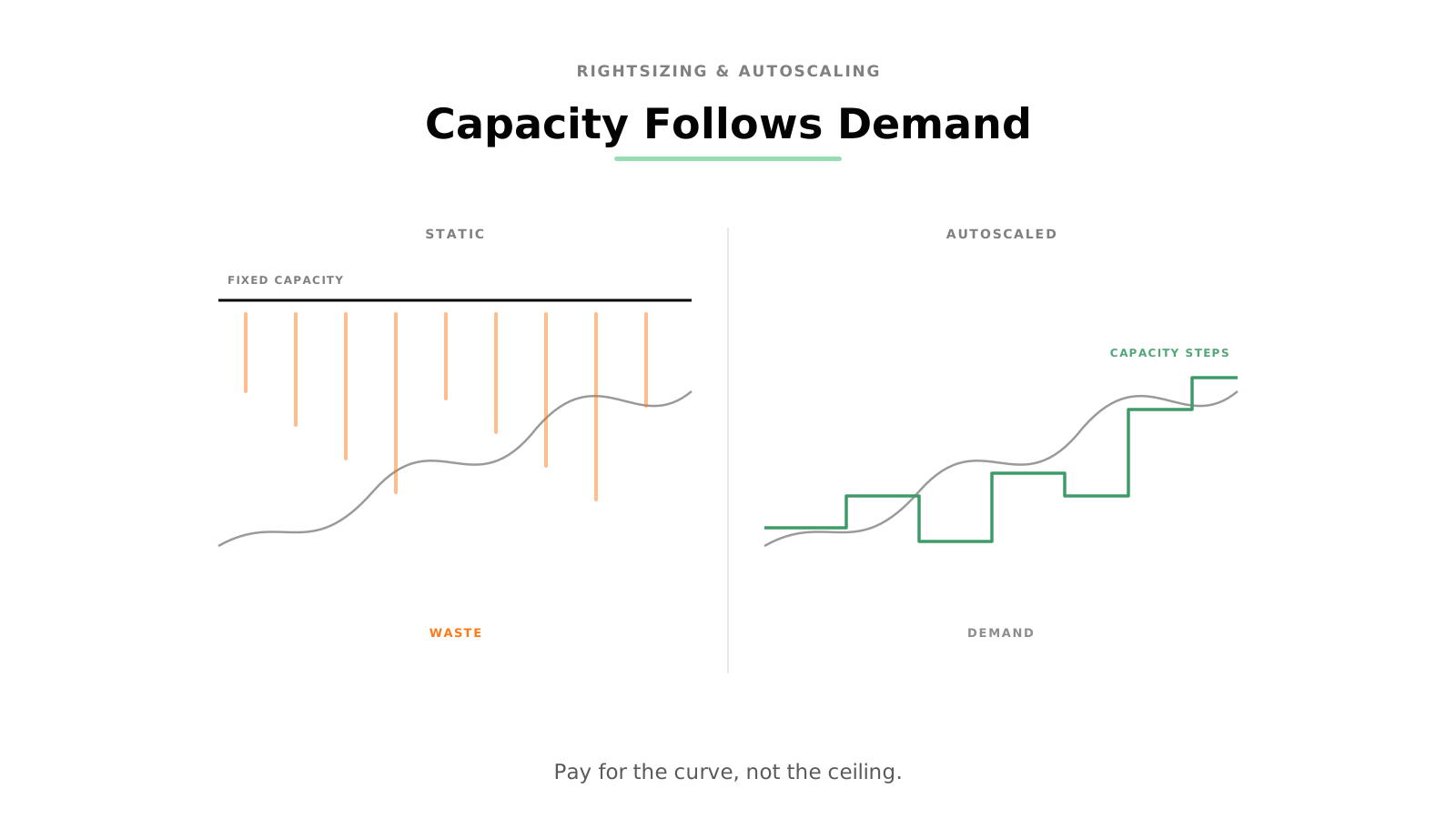
Rightsizing is matching the size of an instance or resource to the workload's actual measured utilization, rather than to a guess made when the workload was first deployed [S57][S56]. The input is utilization data: how much CPU, memory, storage, and network the workload really consumes over a representative window, not how much was requested for it. When the requested size sits well above the observed usage, the instance is oversized and the difference is waste [S04][S57].
There are two directions to resize in. Vertical scaling changes the size of a single instance, giving it more or fewer CPU and memory resources [S57][S52]. Horizontal scaling changes the number of instances behind a workload [S57][S52]. Rightsizing usually means choosing the right instance type and size in the vertical sense and selecting it from a provider's catalogue, which is a combinatorial problem because the catalogue is large and the best fit depends on the workload's resource mix [S57].
The trade-off in rightsizing is headroom. If you size exactly to peak observed usage, you have no buffer for a spike or for the lag while autoscaling reacts, and the workload degrades under load [S04]. If you keep a large buffer, you have paid for capacity that mostly sits idle. The right size is therefore not the smallest size that has ever worked; it is the size that holds a deliberate, justified margin above normal demand. Rightsizing decides the unit you scale. Autoscaling decides how many of those units run at any moment.
REACTIVE VERSUS PREDICTIVE AUTOSCALING
Autoscaling adjusts running capacity as demand changes. It comes in two forms, and the difference matters more than any single tuning parameter.
Reactive autoscaling triggers when a measured metric, such as CPU utilization, crosses a fixed threshold [S57][S52][S43]. It is simple and predictable, but by construction it responds only after demand has already moved. A flash sale or a traffic spike begins, the metric climbs, the threshold trips, and only then does new capacity start to arrive [S57]. For a workload whose demand changes faster than capacity can be added, reactive scaling is always a step behind, and to compensate teams often raise the baseline, which over-provisions under changing demand [S52][S04].
Predictive autoscaling allocates capacity ahead of demand using a forecast of what is coming [S57][S56][S52]. Instead of waiting for the metric to cross a line, the system forecasts the next interval and provisions for it in advance, which is how you absorb a known spike before it lands [S56]. The catch is direct: predictive scaling is only as good as the forecast. A confident but wrong forecast provisions for demand that never arrives, or fails to provision for demand that does. Predictive scaling does not remove the risk of getting capacity wrong; it moves that risk from "reacting too late" to "predicting incorrectly" [S49].
In practice the two are layered, not chosen between. A common pattern uses a forecast to set the baseline for the next window and keeps a reactive rule underneath as a floor that catches whatever the forecast missed [S52][S56]. Predictive handles the expected shape of demand; reactive handles the surprise.
THE DECISION INPUTS AND A SYSTEM MODEL
Strip the tooling away and a capacity-matching decision depends on a small set of inputs: the current and recent utilization of each resource (CPU, memory, bandwidth, latency), the available capacity of each candidate target, the cost of that target, and the workload's tolerance for delay and interruption [S49][S57].
A useful way to read the decision is as a weighted score over candidates. For each place capacity could go, you compare what the workload needs on each resource feature against what that target has free, weight each feature by how much it matters for this workload, and pick the best-scoring target [S49]. In the Tier-A model this article draws on, task-to-cloud assignment is exactly that: a weighted selection across CPU, memory, bandwidth, and latency, fed by a profiling step that continuously updates each target's resource profile from live and historical data [S49]. You do not need that specific algorithm to use the frame. The point is that capacity matching is a multi-criteria decision over utilization-derived inputs, and that making the criteria and their weights explicit is what turns "scale up" into a defensible choice.
Two properties of the inputs shape everything downstream. First, the inputs are noisy and they move, so the profile of each target has to be refreshed continuously rather than measured once [S49]. Second, models built on those inputs drift as workloads and pricing change, so any predictive component needs monitoring and retraining to stay accurate [S57].
FAILURE MODES
Most of the cost and reliability damage in capacity matching comes from a handful of recurring failures. Naming them is half the defense.
Mispredicted demand. Methods that rely on current metrics or past patterns can fail to capture sudden spikes or drops [S49][S04]. A forecast trained on a seasonal pattern does not anticipate an unplanned event; a reactive rule does not see the spike until it has begun. Either way, capacity and demand diverge precisely when it matters most [S04]. The defense is a layered design that does not trust the forecast alone, plus headroom sized for the surprises you cannot predict.
Cold starts. A cold start is the latency incurred when new capacity has to initialize before it can serve traffic [S56][S52]. The instance, container, or function has to spin up, load its runtime, and warm its caches, and that delay arrives exactly when you are scaling out to meet rising load. If your scaling reaction time is slower than the rate at which demand grows, cold starts turn a capacity gap into a user-visible latency gap [S56]. Pre-warming a buffer of capacity, or keeping a warm pool, is the usual counter, and it is a direct cost-for-latency trade.
Over-correction and thrashing. An aggressive controller that scales hard on every fluctuation can oscillate: it scales up on a transient, scales down when it passes, then scales up again, churning capacity without ever settling [S43][S04]. Reinforcement-learning experiments make this trade-off visible. A faster, more aggressive policy can reach higher efficiency but shows greater volatility, while a steadier policy gives up some peak efficiency for consistent stability [S43]. The same spectrum applies to any scaler: tighter thresholds and shorter windows react faster but thrash more. Cooldown periods and stabilization windows exist to damp this.
Over-provisioning and idle resources. The quiet failure is the one that does not page anyone. Capacity left above demand simply runs idle and bills, and threshold-based scalers drift toward over-provisioning because raising the baseline is the easy fix for being a step behind [S52][S04][S57]. This is the failure rightsizing is meant to catch, which is why rightsizing and autoscaling have to be managed together rather than as separate projects.
CROSS-CLOUD NUANCE
Everything above gets harder across more than one provider, for a structural reason. Each cloud exposes its own scaling primitives, its own instance and resource catalogue, and its own pricing, with distinct architectures, APIs, and SLAs [S49][S56]. A scaling policy tuned for one provider's thresholds, cooldowns, and instance families does not transfer unchanged to another; the inputs to the decision are the same, but the levers and their costs differ [S49][S57].
Two consequences follow. First, interruptible capacity is provider-specific: spot or preemptible instances can be reclaimed at short notice, and the early-warning signal you drain against is the provider's own, so the handling has to be built per cloud [S57]. Second, optimization tooling that is native to one provider deepens dependence on it, because the models, policies, and datasets that tooling builds do not move with the workload to another cloud [S57]. The capacity model stays constant across clouds. The implementation does not, and treating a single-cloud configuration as portable is a common and expensive mistake.
THE TRADE-OFF: COST VERSUS RELIABILITY VERSUS LATENCY
Rightsizing and autoscaling are not a cost exercise with reliability as an afterthought. They are a three-way trade. Cutting capacity to the bone minimizes spend but removes the headroom that absorbs spikes, raising the risk of degradation [S04]. Sizing and scaling for guaranteed reliability keeps large margins and warm pools, which costs more and can still add latency through cold starts when a spike outruns the buffer [S56]. Tightening the control loop to react faster improves responsiveness but invites thrashing [S43]. There is no setting that maximizes all three at once. The design choice is to decide, per workload, which of the three is least negotiable, and to size the headroom, the forecast horizon, and the control sensitivity around that priority.
PRACTICAL CHECKLIST
- Rightsize from measured utilization, not requested size, and choose headroom as a deliberate margin rather than a default [S57][S04].
- Layer scaling: use a forecast to set the baseline for the next window, and keep a reactive rule underneath as a floor [S52][S56].
- Make the decision inputs and their weights explicit, so "scale up" is a multi-criteria choice you can defend and audit [S49].
- Add cooldown and stabilization windows to damp oscillation, and treat a steadier loop as worth some lost peak efficiency [S43].
- Budget for cold starts where reaction time is slower than demand growth: pre-warm capacity or accept the latency, but decide on purpose [S56].
- Monitor forecast accuracy and retrain, because models drift as workloads and pricing change [S57][S49].
- Re-tune per cloud; do not assume a policy or tool that works on one provider transfers to another [S49][S57].
LIMITATIONS
The mechanics here are well established, but the published magnitudes are not settled. Reported figures should be read as single-study illustrations, not targets. One Tier-C AWS case study reports a roughly 40% cloud-cost reduction over six months from predictive scaling combined with commitments [S56]. Single-study work reports threshold autoscalers over-provisioning by roughly 25-45% under changing demand [S52][S57], and an industry estimate cited in a Tier-C paper puts idle-resource waste at up to about 30% of cloud spend [S04]. The Tier-A modelling results this article leans on for the decision frame and the failure modes were evaluated in simulation, not in production, so the structure transfers but the numbers do not [S49]. Treat every percentage as a prompt to measure your own environment.
CONCLUSION
Matching capacity to demand is one decision repeated continuously: rightsizing sets the unit, autoscaling sets the count, and a small set of utilization-derived inputs drives both. The hard part is not the happy path but the failure modes, mispredicted demand, cold starts, over-correction, and silent over-provisioning, and the fact that the cost, reliability, and latency you want from a workload cannot all be maximized together. Across clouds, the model stays constant while the primitives and pricing do not, so the implementation has to be re-tuned per provider. Capacity matching is therefore best treated as continuous optimization, supported by clear visibility into utilization and recorded evidence of the decisions taken, rather than as a one-time tuning pass.
CTA
If you are designing capacity matching across more than one cloud, start from the decision inputs and the failure modes, then let the tooling follow. For adjacent decisions, see our companion guides on workload placement across cost, performance, and portability, on commitment strategy for reserved and spot capacity, and on forecasting cloud costs with machine learning.
SOURCES
- S49 Sefati, S. S., Nor, A. M., Arasteh, B., Craciunescu, R., & Comsa, C.-R. (2025). *A Probabilistic Approach to Load Balancing in Multi-Cloud Environments via Machine Learning and Optimization Algorithms.* Journal of Grid Computing, 23:16. https://doi.org/10.1007/s10723-025-09805-6
- S57 Guntupalli, R. (2025). *Predictive cloud resource management.* World Journal of Advanced Research and Reviews, 26(02), 880-885. https://doi.org/10.30574/wjarr.2025.26.2.1522
- S52 Tadisetti, S. S. T. (2025). *Adaptive Multi-Cloud Container Orchestration Using ML-Driven Predictive Scaling.* MSc Research Project, National College of Ireland.
- S43 Varghese, F. (2024). *Dynamic Resource Allocation in Multi-Cloud Environments Using Reinforcement Learning.* MSc Research Project, National College of Ireland.
- S56 Jakkaraju, A. (2024). *Cost-Aware Infrastructure Automation Using Predictive Analytics for Multi-Cloud Environments.* Cuestiones de Fisioterapia, 53(2), 281-296. (SSRN 5222650)
- S04 Rehan, W. (2025). *Optimizing Cloud Computing with AI: Resource Allocation and Cost Management.* Contemporary Journal of Social Science Review, 3(1).
---
DRAFT NOTES, NOT FOR PUBLICATION
- unresolved claims: C13 (~40% saving, S56), C14 (25-45% over-provisioning, S52/S57), C15 (~30% idle waste, S04) all carry and appear only in Limitations.
- legal review needed: none (no legal/regulatory claims).
- product approval needed: C16 single "continuous optimization" closing line, within approved Atomity vocabulary; no feature/result/integration claim.
- images: see SEO block.
- internal links: multi-cloud-workload-placement-cost-performance-portability, multi-cloud-commitment-reserved-spot-strategy, forecasting-cloud-costs-machine-learning-research.
- external citations: S49, S57, S52, S43, S56, S04.
/ GET STARTED
Make Sovereign Cloud Decisions with Confidence
Turn sovereignty requirements into enforceable cloud decisions, with continuous visibility and evidence across providers.