

GCP Egress Costs: How They Work and How to Cut Them
THE BASIC RULES
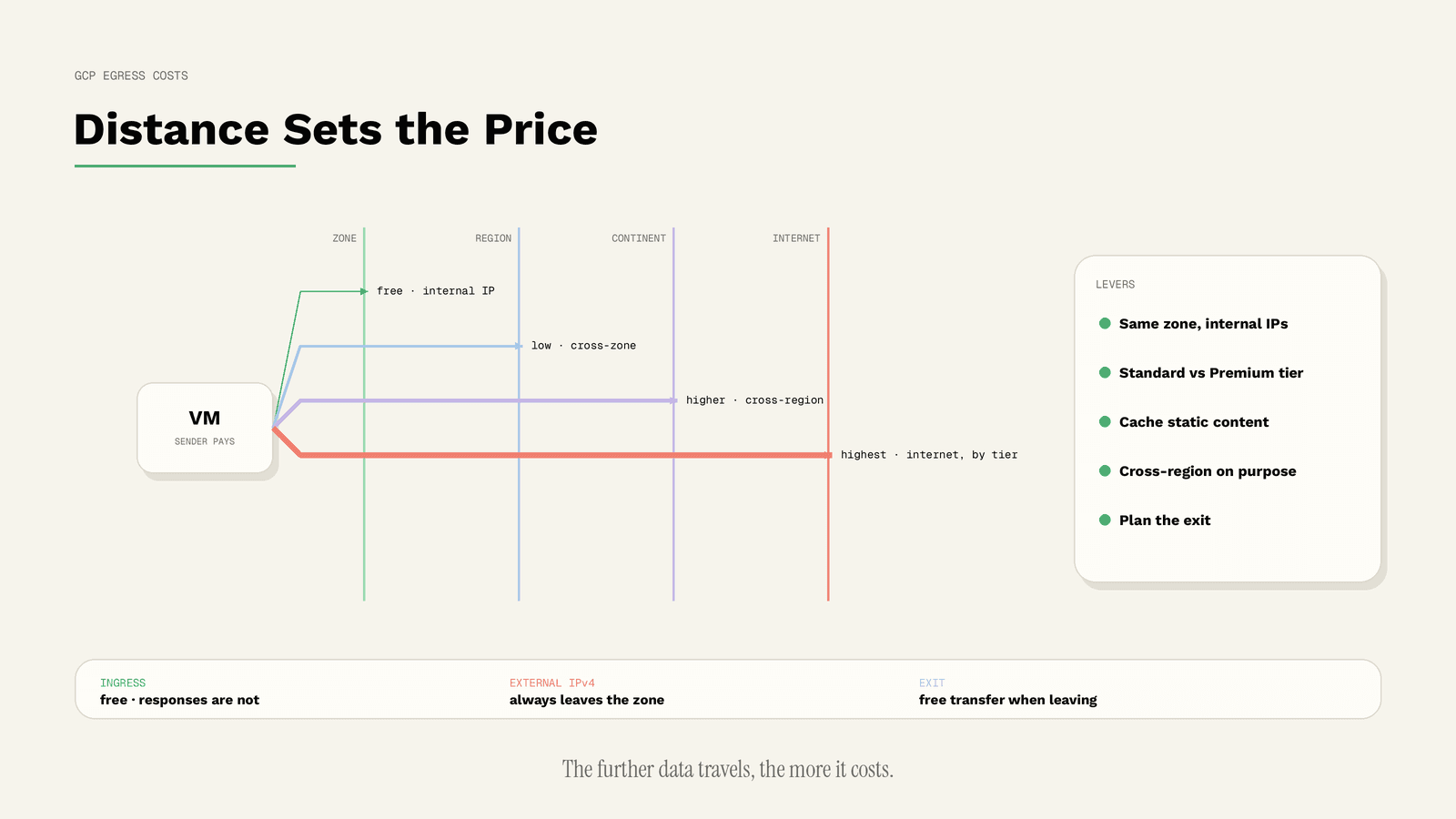
Ingress is free, responses are not. Google does not charge for inbound data transfer, although a resource that processes inbound data may have its own charge. Responses to requests count as outbound data transfer and are charged [W1].
The sender pays. For traffic between virtual machines, the cost is attributed to the project of the VM that sends the traffic. This applies to Compute Engine VMs, GKE nodes and App Engine flexible environment VMs [W1].
Distance sets the price. Google prices VM-to-VM traffic by how far it travels [W1]:
| Path | Price per GiB at retrieval | Note |
|---|---|---|
| Same zone, internal IPv4 or any IPv6, same VPC network | No charge | Keep chatty services here where resilience allows |
| Different zone, same region, same VPC network | $0.01 | Traffic to and from external IPv4 addresses always leaves the zone |
| Different region, within Europe | $0.02 | Per GiB, by continent pair |
| Different region, Europe to North America | $0.05 | Per GiB |
One detail catches many teams out: all traffic to and from external IPv4 addresses leaves the zone, regardless of destination [W1]. Two VMs in the same zone talking over external IPs therefore pay inter-zone rates.
Internet egress depends on the tier. Premium Tier is the default for all Google Cloud data transfer; Standard Tier must be specified explicitly. Standard Tier pricing is based on the source geolocation of the traffic [W1]. Google announced price increases for some Premium Tier internet egress SKUs from 1 February 2024 [W1].
LEVER 1: KEEP TRAFFIC INSIDE THE ZONE AND ON INTERNAL ADDRESSES
The cheapest byte is the one that never leaves the zone. Services that exchange a lot of data, such as an application and its cache, belong in the same zone on internal addresses, as long as your availability design allows it. Where you need multiple zones for resilience, keep the replication traffic deliberate rather than letting every request cross zones.
This is a trade-off, not a free win. Spreading across zones protects availability; concentrating in one zone reduces cost. For how cost, performance and portability interact in placement decisions, see Workload Placement Across Multi-Cloud.
LEVER 2: CHOOSE THE NETWORK TIER DELIBERATELY
Google describes the two tiers plainly: Premium Tier delivers traffic over Google's premium backbone, Standard Tier over regular ISP networks. Google recommends Premium for performance and Standard for cost optimization [W2]. For workloads whose users are mostly in one region and that are not latency-sensitive, Standard Tier can reduce internet egress cost. Check the restrictions first: for Cloud Storage, Standard Tier is only an option when the bucket is a backend for an external Application Load Balancer [W2].
LEVER 3: SERVE STATIC CONTENT FROM CACHE
Cloud CDN uses Google's global edge network to serve content closer to users. When a request is a cache hit, the response comes directly from the edge without going back to the origin. Google distinguishes two charges: data transfer from cache to client (cache egress) and data transfer into the cache (cache fill) [W3].
There is a second effect on load balancer costs. Static objects served from the cache do not transit the load balancer, so an effective caching strategy reduces the outbound data processed by the external Application Load Balancer. Google also notes that blocking unwanted traffic with Google Cloud Armor reduces processed data, because blocked requests do not transit the load balancer [W1]. The first step is to measure which share of your traffic is static and cacheable.
LEVER 4: REDUCE CROSS-REGION DATA MOVEMENT
Inter-region traffic is priced per GiB by continent pair [W1]. Common sources are analytics pipelines that read data in one region and process it in another, backups copied to a distant region by default, and services deployed in several regions without a clear need. Each of these is an architecture decision with a recurring cost, and each deserves an owner.
LEVER 5: PLAN THE EXIT BEFORE YOU NEED IT
Egress is also what makes leaving a provider expensive. On 11 January 2024 Google announced free network data transfer for customers who stop using Google Cloud and migrate their data to another provider or on premises, available globally [W4]. The programme has conditions: you must migrate all workloads and data from the relevant service, submit an exit notice, start within a 30-day initiation period and complete within a migration period of at least 30 days [W5].
The EU Data Act points in the same direction for all providers. From 12 January 2027, providers of data processing services may not charge customers switching charges for the switching process; until then, only reduced charges limited to the provider's direct costs are allowed (Article 29) [W6]. Contracts must also allow switching on request with a transitional period of no more than 30 calendar days (Article 25) [W6]. Our article EU Data Act: Cloud Switching Fees End 12 Jan 2027 covers what this does and does not solve.
Note the difference between the two: the exit programme and the Data Act address the cost of leaving. Everyday egress between zones, regions and the internet remains a normal, billed part of running in the cloud.
HOW TO FIND YOUR EGRESS DRIVERS
1. Break down network SKUs by project. Because the sending project pays [W1], project-level breakdowns show which teams generate the traffic. 2. Separate the four paths. Same zone, cross-zone, cross-region and internet egress have different causes and different fixes. 3. Look for external IPs used internally. They turn same-zone traffic into inter-zone traffic [W1]. 4. Measure cacheability of internet-facing traffic before deciding on CDN [W3]. 5. Review tier settings for workloads that do not need the premium backbone [W2].
LIMITATIONS
Prices in this article are taken from Google's pricing page on 15 October 2026 and change over time; always check the current page and the SKUs for your billing currency. The article does not cover specialised paths such as Cloud Interconnect, peering or Private Service Connect, which have their own pricing. The legal summary of the Data Act is operational analysis, not legal advice.
CONCLUSION
GCP egress costs follow a simple logic: the further data travels from where it was created, the more you pay, and the sender's project pays it. Most reductions come from architecture, keeping chatty traffic close, caching what is static and moving data across regions only on purpose.
Atomity makes those flows visible across clouds. It identifies where data transfer drives cost, compares whether a workload would cost less in another region or on another provider, including European clouds such as IONOS or STACKIT, and turns findings into draft pull requests, Jira tickets and Slack alerts. To see what your data transfer really costs, start with a free cloud cost check.
SOURCES
- [W1] Google Cloud: All networking pricing (VPC, internet data transfer, Cloud Load Balancing). https://cloud.google.com/vpc/network-pricing (accessed 15 October 2026)
- [W2] Google Cloud: Network Service Tiers overview. https://docs.cloud.google.com/network-tiers/docs/overview (accessed 15 October 2026)
- [W3] Google Cloud: Cloud CDN overview. https://docs.cloud.google.com/cdn/docs/overview (accessed 15 October 2026)
- [W4] Google Cloud Blog: Cloud switching just got easier: Removing data transfer fees when moving off Google Cloud, 11 January 2024. https://cloud.google.com/blog/products/networking/eliminating-data-transfer-fees-when-migrating-off-google-cloud
- [W5] Google Cloud: Applying for free data transfer when exiting Google Cloud. https://cloud.google.com/exit-cloud (accessed 15 October 2026)
- [W6] Regulation (EU) 2023/2854 (Data Act), Articles 25 and 29. EUR-Lex. https://eur-lex.europa.eu/eli/reg/2023/2854/oj/eng (accessed 15 October 2026)
/ GET STARTED
Make Sovereign Cloud Decisions with Confidence
Turn sovereignty requirements into enforceable cloud decisions, with continuous visibility and evidence across providers.