

What Providers Have Actually Published About Cloud Switching
INTRODUCTION
Article 29(5) of the EU Data Act requires providers of data processing services to communicate information about services that involve highly complex or costly switching, or where switching is impossible without significant interference with the data, digital assets or service architecture. Article 29(6) requires that information to be publicly available through a dedicated section of the provider's website, or another easily accessible route [W1].
Read plainly, that is an obligation to publish where leaving is hard. It is one of the more unusual duties in the Data Act, because it asks a provider to document its own stickiness, in public, in a form customers can compare.
So we went and read what is published. This article reports what we found in the public switching documentation of three major providers as at 17 September 2026. It reports observations about documents, not conclusions about compliance, and the limitations section explains why that distinction matters.
METHOD
The method is deliberately simple, so that any reader can repeat it and check the result.
For each provider, we located the public page or document that the provider itself presents as its EU Data Act switching material, reachable from its compliance or legal index without a customer login. We then read it against five questions:
- Does it state a position on switching charges?
- Does it implement the Article 25 contractual machinery, and with what timeframes?
- Does it identify any services as complex, costly or impossible to switch away from, as Article 29(5) contemplates?
- Does it address functional equivalence under Article 30?
- Does it carry a version number or an effective date?
We reviewed the documents published by three providers, referred to here as Provider A, Provider B and Provider C, with the source register naming all three and linking the exact documents. The naming convention in the body is a house style choice rather than an attempt to obscure anything.
WHAT IS THERE, AND HOW MUCH IT VARIES
All three providers have published switching material. How closely it tracks the statutory machinery of Article 25 varies more than we expected.
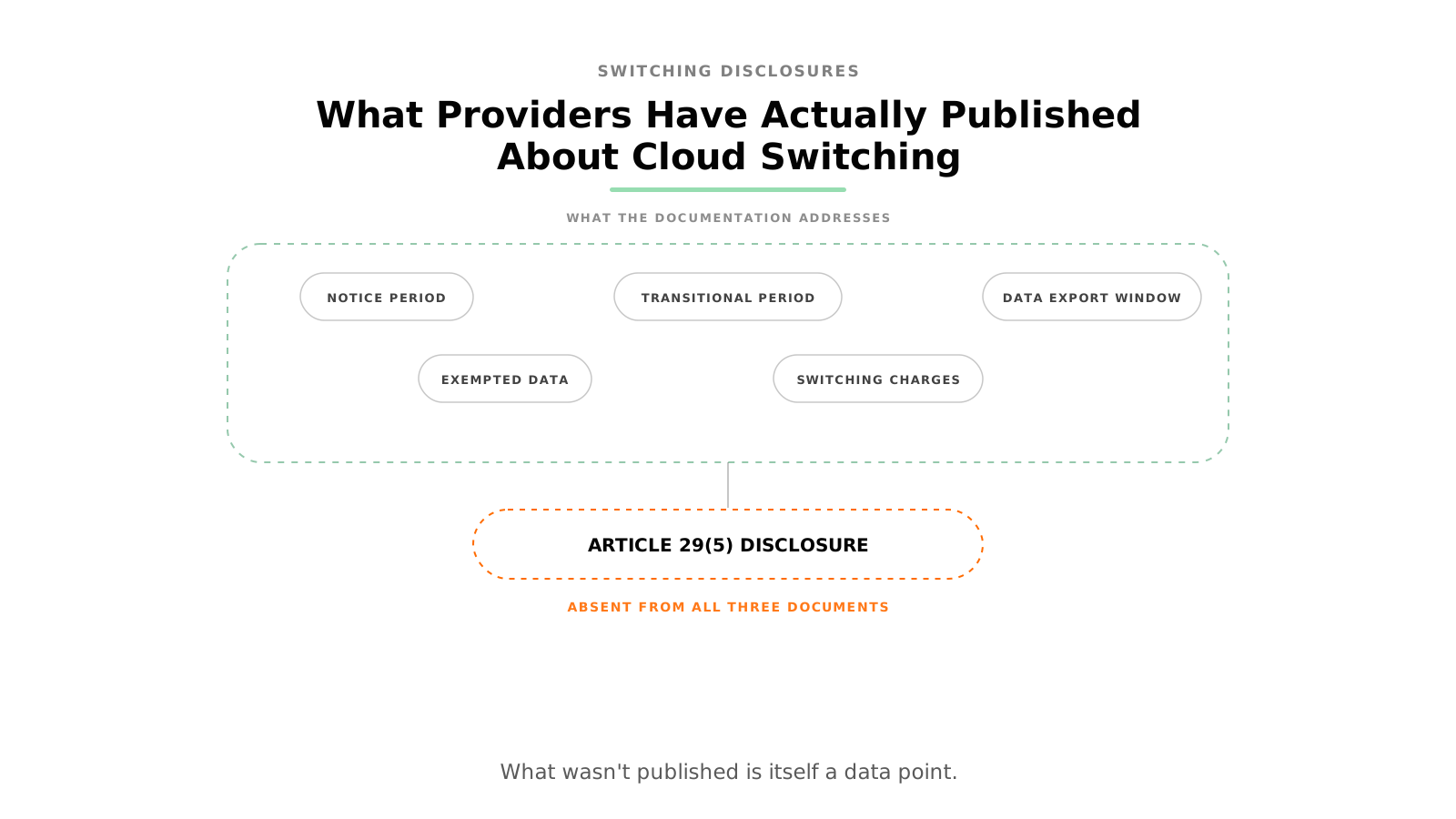
Providers A and B implement the Article 25 mechanics closely and in detail. Both set out a notice period for initiating a switch and a transitional period for completing it. Both provide for the statutory extension where a thirty day transition is not technically feasible, capped at seven months, with the notification duty on the provider. Both give the customer a right to extend the transitional period once. Both describe a data retrieval window after the transition ends and the conditions under which data is subsequently erased [P1][P2][W2].
Provider C takes a different approach. Its terms frame switching as customer-driven rather than as a statutory sequence: the customer "decides when to start exporting" and on what timeline, termination requires sixty days' notice, and export is available for up to ninety days after termination. The document states that "more than 30 days may be required for actual extraction and export" depending on configuration, data volume and the destination [P3]. Read against Article 25, that is a longer retrieval window than the statutory minimum alongside a notably looser treatment of the mandatory thirty day transitional period.
On charges, the three diverge. Provider A states directly that it will not impose any charges for switching as described in its Data Act terms [P1]. Provider B refers to switching-related credits or fee waivers previously provided rather than stating a blanket position [P2]. Provider C states that switching is permitted "at any time at no additional cost beyond the fees and other amounts otherwise due", and separately that a customer "may obtain a reduction in data egress fees associated with Switching and in parallel use as provided under the law" [P3]. A reduction under the law is the Article 29(2) position that expires on 12 January 2027, so that sentence will need to change.
All three carve out, from exportable data, material specific to the internal functioning of the service or protected as a trade secret. Provider A's wording tracks the statutory qualification that the exemption must not impede or delay switching [P1]. Provider B describes the exclusion without reproducing that qualification in the same terms [P2]. Provider C defines its exportable data and digital assets as Customer Data, excluding trade secrets, intellectual property and anything that could compromise the security or integrity of the services [P3].
That last definition is worth pausing on. Article 2(38) defines exportable data to include data generated through the customer's use of the service, which on its face is broader than customer-supplied content alone [W4]. Whether the two definitions come apart in practice depends on how a provider reads its own term, and we express no view on it here.
WHAT IS NOT THERE: THE ARTICLE 29(5) DISCLOSURE
This is the consistent finding, and the reason the article exists.
None of the three documents identifies any service as involving highly complex or costly switching, or as impossible to switch without significant interference. None refers to Article 29(5), or to the disclosure duty, at all, in the material we reviewed.
This is worth stating carefully, because there are several innocent explanations. A provider may take the view that none of its services meets the threshold. A provider may publish the disclosure somewhere other than the document we read. A provider may be treating the duty as one that bites closer to the January 2027 date. The scope of the obligation is genuinely contested, and reasonable lawyers disagree about how far it reaches.
But the customer-facing consequence does not depend on resolving that. A customer who goes looking today for a provider's own statement of where switching is hard, which is precisely what Article 29(6) is meant to make findable, will not readily find one in the primary Data Act material these providers publish.
WHAT IS NOT THERE: FUNCTIONAL EQUIVALENCE
None of the three documents addresses functional equivalence.
Article 30(1) requires providers of infrastructure services, meaning those offering scalable and elastic computing resources limited to infrastructure elements such as servers, networks and the virtual resources needed to run them, to take all reasonable measures to enable a customer to achieve functional equivalence after switching. Article 30(2) requires every other provider only to make open interfaces available free of charge [W3].
That distinction is the single most consequential thing a reader could take from Chapter VI, and it is absent from all three documents. A customer reading them could reasonably conclude that the regime guarantees a working service at the destination. What these documents actually commit to is a data export within defined timeframes. Those are different promises, and for platform and software services the law itself makes the weaker one.
THE DATES, MOSTLY MISSING
Provider C's document carries a version date and a summary of changes, so a reader can tell which version they are looking at and what moved [P3]. Providers A and B carried no visible version number or effective date in the material we reviewed [P1][P2].
This sounds pedantic. It is not. These terms will change between now and 12 January 2027, because the charge position changes by operation of law on that date, and because the Commission may adopt delegated acts establishing a monitoring mechanism for switching charges under Article 29(7) [W1].
A procurement team that captured an undated provider's switching terms in a contract negotiation nine months ago has no reliable way to tell whether the document in front of them today is the same one, or what changed. For a term that will be relied on in an exit scenario, that is a governance gap rather than a formatting complaint. The remedy is on the customer side: capture a dated copy at the point of contracting and diff it periodically.
WHAT THIS MEANS IN PRACTICE
Three things follow for a team preparing for the deadline.
Read the terms, not the coverage. The commentary around this deadline is dominated by the headline that egress fees are ending. The documents show something more specific: defined timeframes, defined exportable data, defined exclusions. Those details govern what actually happens during a switch, and they are more operationally useful than the headline.
Do not assume a data export is a working service. The timeframes in these documents attach to moving data. Reaching functional equivalence at the destination is a separate problem, largely unaddressed in the documents, and in most estates it is where the real work sits.
The UK Competition and Markets Authority reached both halves of this in its cloud services market investigation. In its final decision of 31 July 2025 it found that egress fees are "a key commercial barrier" to switching and multi-cloud, and that "very few customers switch between clouds: less than 1% of customers switch provider each year" [S08]. Examining the free switching programmes that have run since January 2024, it also found uptake low to moderate, with customers describing their switches in months and employees rather than in transfer charges, and concluded that factors other than egress cost deter switching which lower charges alone cannot overcome [S06]. The fee was real, and it was not the whole of it.
Ask the Article 29(5) question directly. If a provider has not published a statement about where switching is hard, that question belongs in the next commercial conversation, in writing. The answer, or the absence of one, is itself useful input into a concentration risk assessment.
WHERE ATOMITY FITS
Atomity maintains the placement position for a workload across providers, evaluated on cost, performance, compliance, sovereignty and operational risk together, and retains the reasoning behind each decision as evidence. Part of that position is what it would take to move, expressed in terms a risk committee can read rather than in transfer charges.
The exercise in this article is one a team can run by hand once. Keeping the answer current across a changing estate, changing provider terms and a changing regulatory position is the part that does not survive being done manually, and that is the part the platform is built for.
LIMITATIONS
This is a documentary snapshot, and several limits apply.
It covers three providers and the material each publishes as its primary EU Data Act switching documentation. It is not a survey of the market, and it does not cover European providers, whose disclosure practice may differ materially and which we intend to review separately.
It reports what is present in and absent from specific public documents on a specific date. Absence from a document is not evidence of non-compliance. A provider may satisfy Article 29(5) through a route we did not review, may reasonably conclude no service meets the threshold, or may publish before the date the duty is treated as biting.
The scope of Article 29(5) is unsettled. There is no authoritative guidance defining highly complex or costly switching, and no enforcement practice yet to calibrate against. Enforcement of Chapter VI generally remains untested; the Data Act became applicable on 12 September 2025 and the charge prohibition takes effect on 12 January 2027.
Finally, this article draws no conclusion about which provider is easier to leave. That question is answered by an organisation's own architecture, not by the length of a provider's terms.
CTA
We intend to repeat this review after 12 January 2027, and to extend it to European providers. If you would like the updated version when it is published, or you want to talk through what your own switching position looks like, get in touch.
SOURCES
- [W1] Regulation (EU) 2023/2854 (Data Act), Article 29, Gradual withdrawal of switching charges, in particular paragraphs 5, 6 and 7. https://eur-lex.europa.eu/eli/reg/2023/2854/oj/eng
- [W2] Regulation (EU) 2023/2854 (Data Act), Article 25, Contractual terms concerning switching. https://eur-lex.europa.eu/eli/reg/2023/2854/oj/eng
- [W3] Regulation (EU) 2023/2854 (Data Act), Article 30, Technical aspects of switching. https://eur-lex.europa.eu/eli/reg/2023/2854/oj/eng
- [W4] Regulation (EU) 2023/2854 (Data Act), Article 2, definitions, including point (38) exportable data. https://eur-lex.europa.eu/eli/reg/2023/2854/oj/eng
- [P1] Google Cloud, EU Data Act compliance mapping and EU Data Act Terms.
- [P2] Amazon Web Services, EU Data Act Addendum.
- [P3] Microsoft, Products and Services Data Protection Addendum, EU Data Act section, and Product Terms, Privacy and Security Terms.
- [S06] Competition and Markets Authority (UK), Cloud Services Market Investigation, Appendix N, "Egress fees, free switching programmes".
- [S08] Competition and Markets Authority (UK), Cloud Services Market Investigation, Summary of Final Decision, 31 July 2025.
/ GET STARTED
Make Sovereign Cloud Decisions with Confidence
Turn sovereignty requirements into enforceable cloud decisions, with continuous visibility and evidence across providers.