

Cost Governance in Multi-Cloud FinOps
CUTTING SPEND WITHOUT GOVERNANCE DOES NOT HOLD
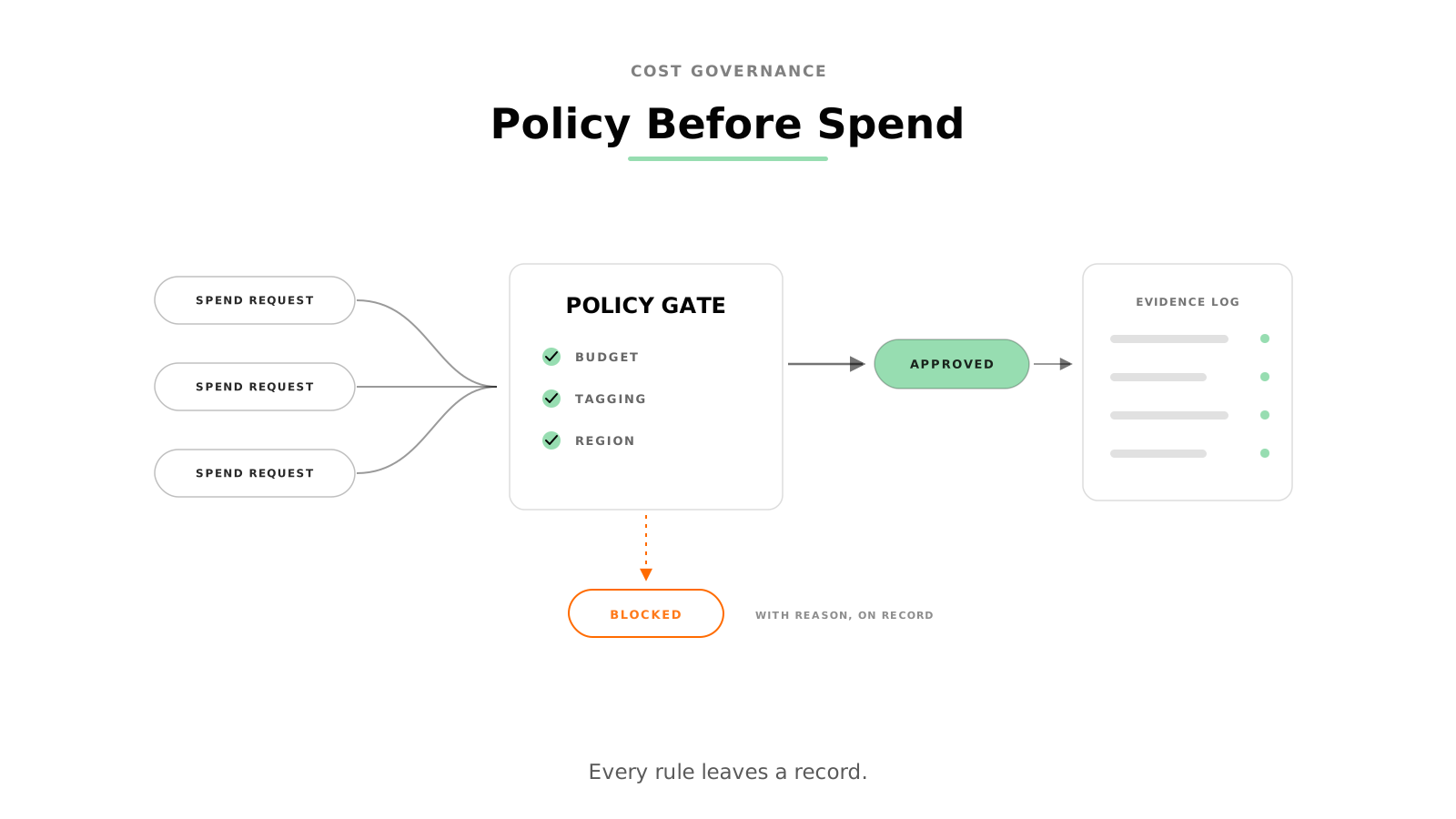
The first problem is that ungoverned cost-cutting is not durable. One systematic treatment of cloud cost optimization makes the point directly: short-term savings can go out of control without governance policies, which is why it treats automated guardrails, policy that institutionalises a decision, as a core phase rather than an afterthought [S12]. Savings achieved once and not held in place tend to erode as new resources are provisioned and old habits return.
The same theme appears in analyses of why cloud budgets overrun in the first place. Inadequate governance frameworks are named as a primary source of budget overruns during cloud migration and operation [S36]. The implication is that cost control is not mainly a measurement problem. Organisations can usually see their spend. The harder problem is governing the decisions that drive it, so that the savings persist and the spending stays accountable. FinOps itself is defined as a discipline that aligns finance, engineering, and operations and drives financial accountability, not merely a way to track costs [S27][S36][S61].
Multi-cloud sharpens all of this. Running across providers fragments visibility and makes governance inconsistent, because each provider exposes cost and policy differently and there is no single consistent control point across them [S32][S36][S27]. Governance that is coherent inside one provider can fall apart across three.
IN REGULATED SECTORS, THE DECISION ITSELF HAS TO BE PROVABLE
For regulated organisations, governance is not only an internal discipline. It is an external obligation, and the object of the obligation is increasingly the decision, not just the outcome.
Analysis of public-cloud transformation in banking, financial services, and insurance describes the pressures directly: data-localization requirements, the need to provide audit access, and regulatory oversight of outsourcing arrangements, alongside the warning that without structured oversight cloud consumption leads to unpredictable expenses and budget overruns [S61]. That analysis comes from a consulting source and is attributed as such, but it is consistent with the direction of European regulation.
On the law itself, two instruments are worth separating from interpretation. The Digital Operational Resilience Act, Regulation (EU) 2022/2554, applies from 17 January 2025 and governs information and communication technology risk in the financial sector, including the oversight of third-party providers and concentration risk [W1]. The EU Data Act, Regulation (EU) 2023/2854, entered into force on 11 January 2024, with most provisions applying from 12 September 2025, and introduces harmonised rules including cloud-provider switching and interoperability [W2]. These are the legal texts. How a given organisation must respond to them is a matter for qualified interpretation and is not legal advice. The relevant point for cost governance is that both regulations push organisations toward being able to demonstrate and justify how their cloud arrangements are structured, which is a question about decisions and evidence, not only about spend.
WHAT FINOPS TOOLING DOES, AND WHAT IT DOES NOT
Here it is important to be careful and to label analysis as analysis. FinOps platforms are genuinely good at what they do. They make spend visible, allocate it, forecast it, recommend optimizations, and in mature setups automate parts of the response. The observation that follows is Atomity's reading of the combined evidence rather than a direct claim from any single source.
That reading is this: optimising and reporting spend is not the same as capturing why a spending or placement decision was made and producing evidence an auditor could later review [S12][S27][S36][S61]. A FinOps tool can show that a workload moved and that the bill fell. It is not generally designed to record that the move was evaluated against a defined policy, that the trade-offs across cost, performance, residency, and resilience were weighed, that an accountable owner approved it, and that all of this is retained as a durable, reviewable record. The gap is not in the cost mathematics. It is in the decision rationale and the evidence around it.
This distinction is easy to miss because FinOps is often described as including governance and accountability [S27][S36]. It does, as a discipline. The practical gap is that the tooling centres on cost visibility and optimization, while the decision-rationale-and-evidence layer is left to spreadsheets, tickets, and email, which do not survive an audit well.
WHAT CLOSING THE GAP REQUIRES
If the problem is policy and evidence over decisions, the requirements for closing it follow from that.
First, policy over the decision, not just the resource. Guardrails that institutionalise a cost decision through automation are part of the answer, because they hold a correction in place beyond the individual who made it [S12]. But policy also has to express the rules a decision must satisfy, for example which workloads may move where, given residency and resilience constraints, not only which resource sizes are allowed.
Second, recorded rationale. The reasoning behind a material decision, the criteria considered and the trade-offs accepted, needs to be captured at the time, not reconstructed afterward. Reconstruction is where audit trails fail.
Third, evidence and attestation. There has to be a durable, reviewable record that a decision was made, against which policy, and with what justification, so that the organisation can demonstrate it rather than assert it [S61][S32]. Data governance work in multi-cloud points the same way, toward centralised policy with consistent enforcement, accountability, and lineage across providers [S32].
Fourth, multiple criteria, not cost alone. In a regulated context the decision weighs cost against compliance, operational, and sovereignty considerations together. A layer that governs only cost will systematically miss the criteria that auditors and regulators care most about.
THE ROLE OF A CONTROL LAYER
These requirements describe a function that sits above individual cloud and cost tools: a control layer whose job is to make, enforce, monitor, and prove workload decisions across environments, rather than to optimise spend within one. The concept is general, and an organisation could approach it in several ways.
This is the function Atomity is built to serve. Atomity helps regulated enterprises and public-sector organisations make, enforce, monitor, and prove cloud workload decisions across sovereign, hybrid, and multi-cloud environments. In the cost-governance context specifically, that means applying defined policy to decisions, evaluating sovereignty, compliance, operational, and cost criteria together rather than cost in isolation, recording evidence of how a decision was reached, and supporting continuous auditability so the decision can be reviewed later. The aim is to give cost decisions the policy and evidence layer that optimisation tools were not designed to provide.
WHAT THIS DOES NOT REPLACE
Precision matters here, because it is easy to overstate. A control layer of this kind does not replace a FinOps platform: the optimisation, allocation, and reporting work still belongs there, and the two are complementary. It does not replace an auditor or a regulator, who reach their own conclusions. It does not replace a legal team, and nothing here is legal advice. And it does not, on its own, guarantee compliance or any cost outcome. What it adds is narrower and specific: policy and evidence over the decisions, so that a regulated organisation can show its work.
CONCLUSION
In regulated multi-cloud environments, the question is shifting from "how much did we spend" to "can we prove why we spent it that way." FinOps answers the first question well. The second is a governance question about policy and evidence over decisions, and it is the one most cost programmes are not yet built to answer.
Map the cost decisions your auditors would ask you to justify, and check whether you could produce the rationale and the evidence today, or only reconstruct them later. The honest answer usually shows where the governance work has to start.
SOURCES
- [W1] Regulation (EU) 2022/2554 (Digital Operational Resilience Act, DORA), applicable from 17 January 2025. https://eur-lex.europa.eu/eli/reg/2022/2554/oj/eng
- [W2] Regulation (EU) 2023/2854 (Data Act), in force 11 January 2024; most provisions apply from 12 September 2025. https://eur-lex.europa.eu/eli/reg/2023/2854/oj/eng
- [S12] Kasireddy, J. R. (2025). *The Cloud Cost-Optimization Flywheel.* IJAESIT. (Tier C.) Governance-lack and guardrails.
- [S61] Gogoi, R. (2025). *Public Cloud Transformation in BFSI: Innovation, Regulatory Governance, Security Architecture, and Emerging Business Models.* Next Move Strategy Consulting / SSRN. (Tier B; consulting source, attributed.)
- [S36] Sajja, J. W., Komarina, G. B., and Choppa, N. K. R. (2025). *The Convergence of Financial Efficiency and Sustainability in Enterprise Cloud Management.* JCSTS. (Tier C.)
- [S27] Kodi, D. (2025). *Multi-Cloud FinOps: AI-Driven Cost Allocation and Optimization Strategies.* ICCSAIML'25. (Tier C.)
- [S32] Kopparapu, V. S. (2025). *Unified Data Governance Strategies for Multi-Cloud Ecosystems.* JAAFR. (Tier C.)
/ GET STARTED
Make Sovereign Cloud Decisions with Confidence
Turn sovereignty requirements into enforceable cloud decisions, with continuous visibility and evidence across providers.